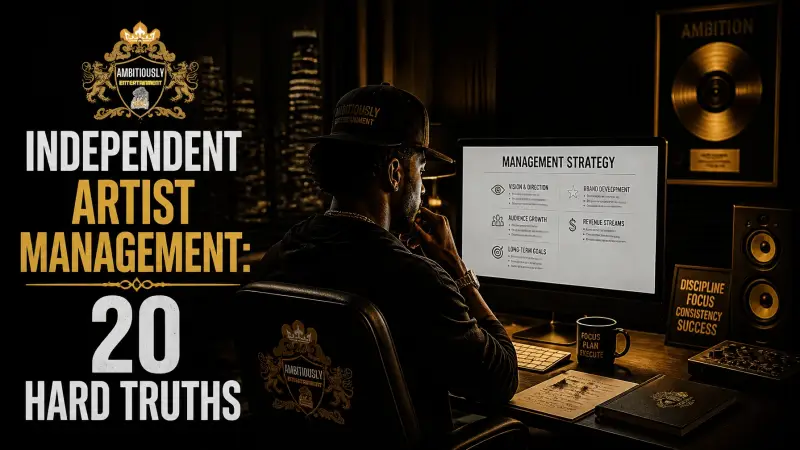
Let’s be real for a second: the dream of being "discovered" while singing in your bedroom or posting one viral clip is a beautiful story, but it’s rarely a business plan. We’ve all seen the documentaries where a manager swoops in, signs a check, and suddenly the artist is on a private jet. But in the 2026 landscape, the bridge between "talented dreamer" and "professional artist" isn't paved with luck, it’s built on the unglamorous, grit-heavy foundation of management.
Whether you’re looking to manage yourself or trying to become "manageable" for a pro, you have to face the music before you can make it. Have you ever wondered why artists with half your talent are getting twice your bookings? Or why your latest release felt like throwing a pebble into the ocean?
It’s usually not the music. It’s the management.
At Ambitiously Entertainment, we see this every day. We’re in the business of elevating talent, but we’ve learned that transformation only happens when you stop treating your career like a hobby and start treating it like a high-stakes startup.
Here are the 20 hard truths about independent artist management that nobody wants to tell you, but everyone needs to hear.
The Strategic Pivot: From Artist to CEO
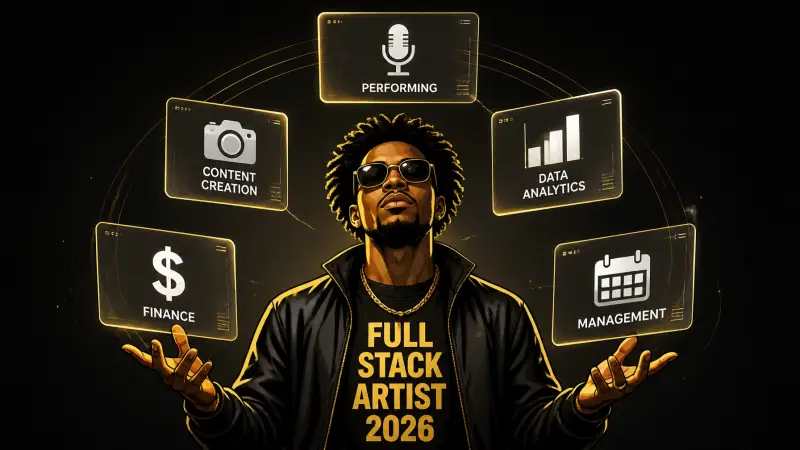
Research into the 2026 music industry shows that the most successful independent artists function less like "creatives" and more like "full-stack solo businesses." Studies suggest that artists who spend at least 40% of their time on the business and strategy side of their career see a 3x higher retention rate in their fanbase compared to those who focus solely on the art.
If you want to move the needle, you have to stop waiting for a savior and start being your own strategist.
1. You are a CEO, not just a singer
The moment you decide to sell your music, you aren't just an artist; you’re the CEO of a media company. Management is about overseeing production, marketing, legal, and finance. If you don't want to wear the hat, don't expect to keep the crown.
2. Talent is the floor, not the ceiling
Being "good" is the bare minimum requirement to enter the building. There are millions of "good" singers. Management is the process of taking that talent and wrapping it in a brand that people actually want to buy into.
3. Management starts with self-management
No professional manager will touch an artist who can’t manage their own schedule, emails, and basic social media presence. Why would they invest their time in your career if you haven't shown you can handle the basics?
4. Your first manager will likely be your bank account
In the early days, you are the primary investor. You’ll be the one paying for the studio time, the mixing, and the promotion packages. Management is about deciding how to spend that money strategically rather than just burning it on "vibes."
5. Networking is a currency
It’s not just who you know; it’s who knows how professional you are. Management is about building a "social capital" account. Every bridge you burn or email you ignore is a withdrawal from your future success.
6. Content is the "rent" you pay for attention
In 2026, you can’t just disappear for six months to "find your sound." Management requires a content strategy that keeps you visible. If you’re not posting, you don’t exist in the eyes of the algorithm.
7. Data is your crystal ball
Stop guessing. Management is about looking at your Spotify for Artists or YouTube Analytics and seeing where people are actually listening. If your fans are in Baltimore, why are you trying to book a tour in Seattle? Use the data to elevate your strategy.
8. Consistency > Intensity
One massive viral moment is great, but management is about what happens the week after. It’s better to release one solid track every two months than to drop a 20-song album and go silent for two years.
9. Professionalism is your superpower
The music industry is notorious for being disorganized. If you show up on time, have your files ready, and follow up on emails, you’re already ahead of 90% of the competition.
10. Contracts are not suggestions
Management involves a lot of "boring" paperwork. Never sign anything you don't understand, but don't be afraid of contracts. They aren't there to trap you; they're there to define the relationship so you can focus on the work.
11. Your "team" might just be your phone (at first)
You don’t need an office in Midtown to have a team. Your "team" is the distribution service you use, the AI tools you use for editing, and the radio platforms you partner with. Harness these tools intentionally.
12. Radio still matters (the right kind)
While FM might be fading, digital urban radio platforms like Ambitiously Radio are thriving. Being part of a curated community gives you a stamp of authority that a random playlist simply can't provide.
13. "Exposure" is a tool, not a paycheck
A good manager knows when to take a "free" gig for the strategic value and when to walk away. If the exposure doesn't lead to data, fans, or future money, it’s just a distraction.
14. Rejection is your personal trainer
You will hear "no" more than "yes." Management is about analyzing why the "no" happened. Was the song not right for the format? Was the pitch too long? Use rejection to refine your approach.
15. Fans are grown, never bought
You can buy followers, but you can't buy a fan who will drive two hours to see you perform. Management focuses on community-building, not just vanity metrics.
16. The "Big Break" is a myth
Success in this industry is a series of "small breaks" that eventually look like a big one to people looking from the outside. Management is the art of stacking those small wins day after day.
17. Your brand is what they say when you're not there
Your brand isn't your logo; it’s your reputation. A manager’s job is to protect that reputation. Are you known for being an innovator? A hard worker? A visionary? Make sure the narrative matches the music.
18. Mental health is your biggest asset
The "hustle culture" of the music industry can be toxic. Management includes setting boundaries. You can't produce world-class content if you're burnt out and miserable. We talk about this often on Ambitiously The Podcast: the mindset is just as important as the music.
19. Distribution is the easy part
Anyone can get a song on Spotify. Management is what happens after the song is live. If you don't have a 4-week post-release plan, you haven't really released the song; you've just uploaded it.
20. You have to be your own biggest investor
If you aren't willing to spend your own time, money, and energy on your career, why should anyone else? Professional management comes to those who are already moving at 100mph.
The Problem-Solution Framework: Is Your Career Stuck?
Most independent artists suffer from "The Creative Paradox": they have the talent to create but lack the systems to scale. They treat management as a passive habit: something they’ll "get to" once they’re famous: rather than the curated strategy required to get famous.
The Missed Opportunity: Spending $2,000 on a music video but $0 on promoting it.
The Strategic Remedy: Reallocate your budget. Spend $500 on the video and $1,500 on a multi-channel promotion strategy that includes digital radio features and targeted social ads.
Your Management Assessment Criteria
Before you look for a manager (or commit to managing yourself), ask yourself these four questions:
- Operational Readiness: Do I have a clean, professional Electronic Press Kit (EPK) ready to send today?
- Financial Clarity: Do I know exactly how much I spent on my music last month and exactly how much I earned?
- Brand Consistency: If I showed my Instagram to a stranger, would they know exactly what kind of music I make within 5 seconds?
- Data Literacy: Can I identify which 3 cities have my highest listener concentration right now?
Elevate Your Journey
Navigating the independent music world is a marathon, not a sprint, and you don’t have to run it alone. Whether you’re looking for a platform to showcase your sound on Ambitiously Radio or you need the strategic insights found on Ambitiously The Podcast, we’re here to help you unlock that next level.
The "hard truths" aren't meant to discourage you: they're meant to arm you. Once you stop fighting the reality of the business, you can start winning at it.
Ready to stop guessing and start growing? Connect with us at Ambitiously Entertainment today. Let’s talk about how we can help you build a management strategy that actually works.
Add comment
Comments